








Watch Our Story

Premium Export Quality Fiberglass Idols

Authentic Indian Craftsmanship

Compliance with International Standards

Customization As Per Requirements

Light Weight & Easy To Handle

Long Life And Reusable

Proven Global Export Record

Complete End-to-End Support

Categories of Product

durga-type

Fiberglass 5 Chali Maa Durga Statue

durga-type

Fiberglass Akchala Durga Idol

durga-type

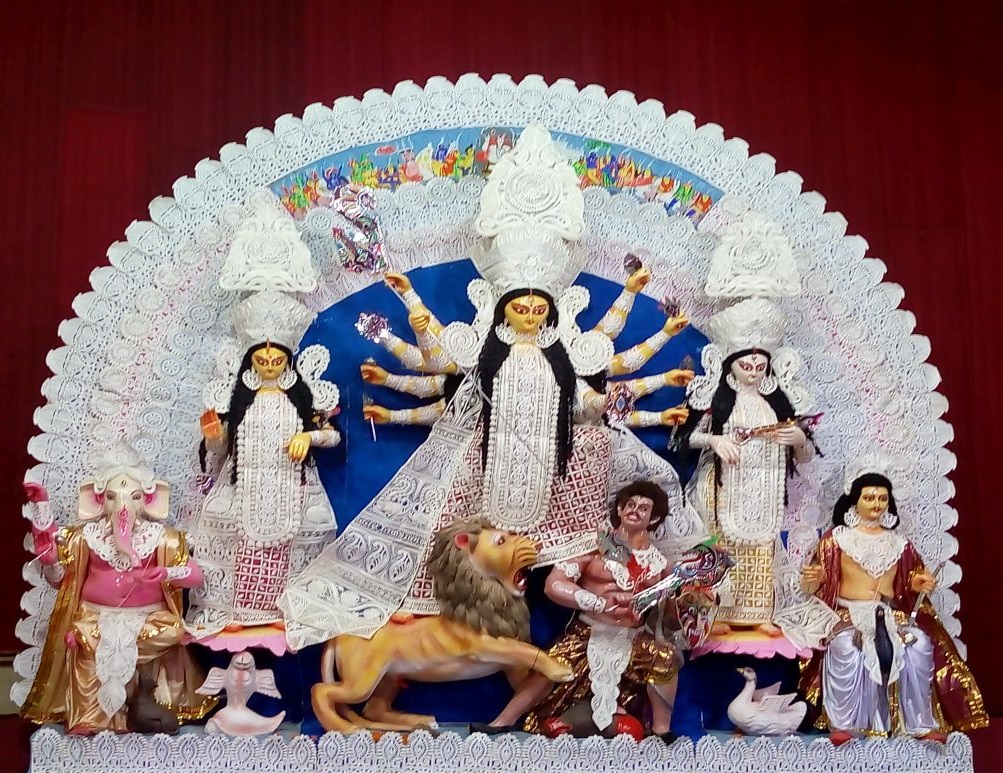
Fiberglass Maa Durga Traditional Looks

durga-type

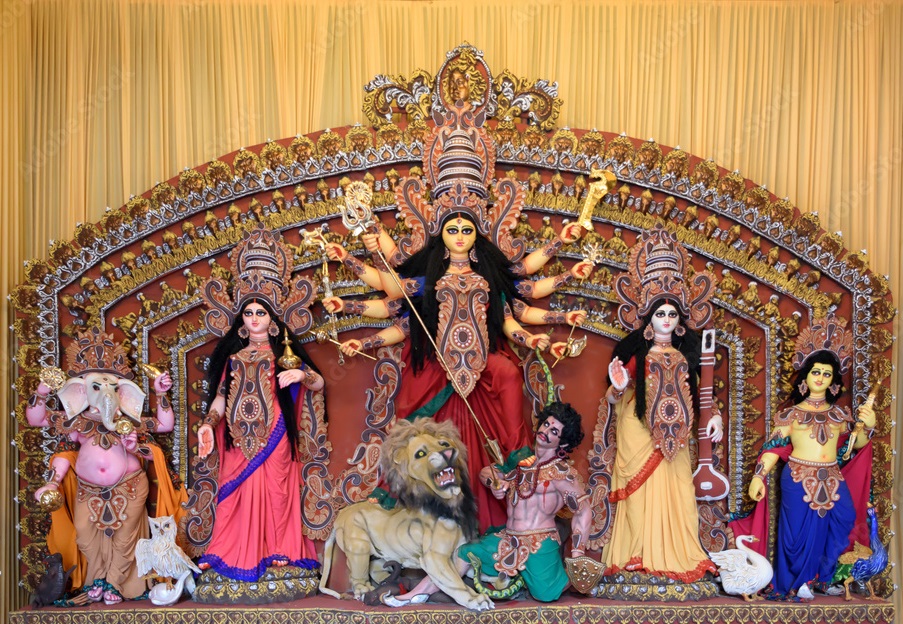
Bengali Maa Durga Idol

Durga Idols

About Us

Welcome to Fiberglass Durga, the leading manufacturer and exporter of high-quality fiberglass Durga idols. Our mission is to bring a touch of Indian culture and tradition to homes and communities around the world through our exquisite Durga idols.

As a team of skilled craftsmen and artisans with over 20 years of experience in the industry, we take pride in creating stunning fiberglass idols that are not only visually appealing but also durable and long-lasting. Our state-of-the-art production facility ensures that each idol is meticulously crafted with attention to detail, using only the finest materials.

We understand the importance of Durga idols in worship and cultural celebrations, which is why we are committed to providing our customers with top-notch products that exceed their expectations. Join thousands of satisfied customers from different countries who have chosen Fiberglass Durga for their home décor and puja needs. Let us help you bring a piece of India into your home or community today!

Best Selling Durga Idols

Our Blog

See All Blogs
  • 🌸 Preserving the Soul of Kumartuli: How Modern Technology Replicates Traditional Clay Artistry in a Fiberglass Durga Idol

    The Artistry Question That Every Discerning Buyer Asks

    ⚡ Quick Summary
     • Every Fiberglass Durga Idol begins with a hand-sculpted clay original by Kumartuli-trained master artisans.
    • High-precision silicone/fiberglass negative molds capture every micro-detail — wrinkles, jewelry, fabric folds.
    • Matte primers and multi-layer hand-painting replicate the organic warmth of natural clay.
    • Bronze, terracotta, and stone-effect finishes are available for premium interior and corporate spaces.
    • Fiberglass is immune to moisture, cracking, pests — everything that makes clay fragile.

    Close your eyes and bring to mind the face of Ma Durga as she appears in a master Kumartuli idol. The slight tilt of her head. The precise curve of her eyes — almond-shaped, elongated, carrying a quality that seems simultaneously fierce and compassionate. The fine raised work of her crown, the articulation of her ten hands, each holding its sacred implement with absolute iconographic precision.

    Now consider the anxiety that grips many traditional Puja organizers when they first hear the word “fiberglass.” Will it look plastic? Will it have that cold, manufactured sheen? Will the divine warmth — that quality of sacred presence that seems to emanate from a truly well-made clay Pratima — survive the translation to a modern polymer?

    The answer, when you understand how a professional Fiberglass Durga Idol is actually made, is an unequivocal yes. Not despite the technology — because of it. This article explains the complete manufacturing process that makes it possible.

    The Fiberglass Durga Idol Begins in Clay: The Master Mold Process

    Step 1: The Hand-Sculpted Clay Original

    The production of every Fiberglass Durga Maa Idol begins not with a machine, a computer model, or a 3D printer. It begins with river clay, a master sculptor’s hands, and the accumulated knowledge of a living artistic tradition.

    At Fiberglass Durga, we work directly with sculptors trained in or connected to the Kumartuli tradition — the legendary potter’s quarter in north Kolkata where the art of Durga Pratima sculpting has been practiced without interruption for over three centuries. These artisans do not work from generic templates. Each figure is sculpted from first principles, following the Shastriya iconographic conventions that govern every proportion — the precise ratio of the goddess’s facial features, the angle and reach of each arm, the posture of the lion, the defeated attitude of Mahishasura at her feet.

    The result is a clay original of genuine artistic authority — not a production prototype, but a work of sacred art in its own right.

    Step 2: The High-Precision Negative Mold

    This is where technology becomes the tradition’s most faithful servant. Once the clay original is complete and approved — by the client, and by our master sculptors — a high-precision negative impression is taken of the entire figure.

    The mold-making process uses silicone rubber for fine-detail surfaces (capable of capturing detail at sub-millimeter resolution) and fiberglass for the rigid outer jacket that maintains the mold’s dimensional stability. The result is a negative that locks in every feature of the original clay sculpture with absolute fidelity:

    • Every micro-wrinkle in the goddess’s face
    • Every individual strand of her sculpted hair
    • The raised relief of each ornamental jewel on her crown and bangles
    • The texture of fabric folds in her garments
    • The anatomical musculature of the lion’s body
    • The fine articulation of each finger

    When a fiberglass casting is produced from this mold, it carries every one of these details in permanent, dimensionally stable form. The clay original may eventually be recycled back to earth — but its artistic soul is immortalized in every casting produced from the mold.

    You can explore our full range of artisan-crafted designs at fiberglassdurga.com/idols_list/crafting-fiberglass-durga-idol-beyond-kumartuli-durga-idol.

    Overcoming the ‘Plastic Look’: The Secret Is in the Finishes

    The Matte Clay Finish: Organic Warmth in Fiberglass

    The most significant reason that poorly made fiberglass sculptures look “plastic” is a surface finish problem, not a material problem. A raw, untreated fiberglass casting has a smooth, slightly glossy surface that reads as synthetic. The solution is a multi-stage hand-finishing process that transforms this surface into something that reads as fundamentally organic.

    At Fiberglass Durga, our matte finish process involves:

    1. Base Priming: A specialized matte-formula primer is applied across the entire surface, creating a micro-textured base that breaks the synthetic sheen and introduces the slight surface irregularity characteristic of natural clay.
    2. Multi-Layer Hand Painting: Colours are applied by hand in multiple thin layers — exactly as a skilled clay idol painter works. Each layer dries and is gently abraded before the next is applied, building depth, tonal variation, and the slight inconsistency that gives natural materials their visual richness.
    3. Detail Articulation: Fine detailing — the kohl-dark inner eyes, the precise vermillion of the bindi, the gold highlights of jewellery — is applied with fine brushes by experienced artisans, often the same painters who work on traditional clay Pratimas.
    4. Matte Sealing: A final matte-formula UV-resistant sealing coat is applied that locks all painted layers while maintaining the non-reflective, earth-like surface quality of the finish.

    The result is a surface that, in photographs and in person, is indistinguishable from a finely painted clay idol — while being structurally superior in every dimension.

    Premium Finish Variants for Luxury and Corporate Spaces

    For luxury homeowners, corporate lobbies, art collectors, and premium pandals seeking a sculpture that reads as a collector’s object rather than a devotional utility, Fiberglass Durga offers several premium finish variants:

    Museum-Grade Bronze: A multi-layer metallic coating system produces a surface indistinguishable from aged cast bronze — including the characteristic verdigris patina of old bronze work. This finish transforms the idol into a museum-quality art object suitable for permanent installation in corporate reception areas, luxury residences, and institutional collections.

    Terracotta Effect: A warm, earthen-toned finish that replicates the rich, matte orange-brown of traditional fired terracotta. This finish is particularly striking for natural-light spaces and heritage-style interiors.

    Stone Effect (Granite / Sandstone): A textured finish system that replicates the visual properties of carved stone — suitable for temple environments, outdoor garden installations, and heritage-style architectural contexts.

    Polished Gold Gilt: A traditional gilt finish replicating the gold-leaf ornamentation of classical Bengali Durga iconography, for committees and collectors seeking maximum devotional visual impact.

    Browse available finish options for home installations at fiberglassdurga.com/idols_list/fiberglass-durga-maa-idol-for-home.

    Weatherproofing the Divine: Why Fiberglass Outlasts Clay

    Beyond aesthetics, there is a practical dimension to the choice of fiberglass that matters deeply to anyone commissioning a permanent or long-term installation:

    • Moisture Immunity: Clay absorbs atmospheric moisture, which over time causes micro-cracking, surface spalling, and eventual structural failure. Fiberglass is completely impervious to moisture, making it equally suitable for indoor and outdoor installation in any climate.
    • Pest Resistance: Traditional clay murtis stored between seasons are vulnerable to termite infestation. Fiberglass contains no organic material that supports pest activity.
    • Thermal Stability: Clay cracks under repeated thermal cycling — the seasonal expansion and contraction that affects outdoor installations in continental climates. Fiberglass has a dramatically lower thermal expansion coefficient, virtually eliminating thermally induced cracking.
    • Structural Longevity: A properly maintained Fiberglass Durga Idol carries a realistic service life of 15 years or more — versus a clay idol’s single-season utility.

    Conclusion: Technology in Service of Tradition

    The greatest misunderstanding about the Fiberglass Durga Idol is the assumption that technology has replaced the artist. The reality is precisely the opposite.

    The master sculptor’s hands still shape the original. The Kumartuli tradition’s iconographic precision still governs every proportion and expression. The artisan painter’s skill still brings the face to life, colour by colour, layer by layer. What fiberglass technology provides is permanence — the ability to immortalize the master’s creation in a form that will endure long after the clay from which it was born has returned to the river.

    Explore our artisan design gallery at fiberglassdurga.com/fiberglass-durga-maa to browse available postures, compositions, and finish options. For custom theme modifications or commission enquiries, call our team at +91-7278604751 — and let us help you bring a truly immortal Ma Durga home.

  • 🌸 The Sustainable Celebration: Why Gated Communities Are Choosing a Fiber Durga Idol for Eco-Friendly Pujas

    The Environmental Cost of a Beautiful Tradition

    ⚡ Quick Summary
     • A reusable Fiber Durga Idol eliminates river pollution from toxic paints and non-biodegradable plaster.
    • A single investment lasts 10–15 years, eliminating recurring annual clay idol procurement costs.
    • Modern gated communities use spray or tank immersion rituals to preserve Bijoya Dashami traditions.
    • Fiberglass surfaces are easy to clean, re-dress, and store between festival seasons.

    Every Bijoya Dashami, across thousands of Indian cities and towns, an ancient ritual of farewell plays out with profound emotional weight. Ma Durga, worshipped for five days with devotion, flowers, and music, is carried to the nearest ghat for immersion — her return to the cosmic waters that birthed her.

    But the waterways that receive her today are telling a different story. River pollution data from India’s major urban water bodies shows alarming spikes in lead, cadmium, and chromium concentrations in the days following mass idol immersion. Non-biodegradable plaster of Paris and synthetic chemical paints persist in riverbeds for months, disrupting aquatic ecosystems and contaminating water supplies.

    For progressive housing society committees across Delhi, Mumbai, Bengaluru, Hyderabad, and Pune, this reality is creating a genuine dilemma — one that a premium Fiber Durga Idol is uniquely positioned to resolve, without any compromise to the spiritual depth or cultural authenticity of the celebration.

    Redefining the Immersion Ritual: Ghat Bhashan Without the Ghat

    The Modern Eco-Immersion Approach

    Across India, a growing number of Puja committees — supported by urban local bodies and environmental NGOs — are adopting symbolic immersion practices that preserve the ritual’s spiritual essence without the ecological cost of river immersion.

    The two most widely adopted approaches for housing society celebrations are:

    1. The Water Spray Ritual: The Fiber Durga Idol is sprinkled with sacred water — Ganga jal or water from a designated clean source — by the priest while mantras are recited. The ritual of sending Ma Durga back to her celestial home is completed through intention, prayer, and symbolic gesture rather than physical submersion.
    2. The Designated Clean-Water Tank: Some larger housing complexes install a small, clean water tank within the premises specifically for symbolic idol immersion. The water, containing no toxic pigments or plaster residue from the fiberglass idol, is subsequently treated and released responsibly.
    Spiritual Alignment: Protecting Creation While Honoring the Creator

    Many scholars of Shakta tradition note that the immersion ritual’s spiritual purpose — the return of the divine form to its elemental source — is fulfilled through the sincerity of the ritual act, not the literal destruction of the murti. A community that chooses to honor Ma Durga through a beautiful, permanent sculpture — and bids farewell through a respectful symbolic ritual — is participating in the tradition’s deeper spirit.

    The Fiberglass Durga becomes not a compromise, but a conscious evolution of the tradition — one that the Mother Goddess, as the protector of creation, might be said to actively encourage.

    The Financial ROI of Reusability: A 15-Year Analysis

    For housing society finance committees, the economic case for a permanent Fiber Durga Idol is compelling and straightforward:

    Annual Clay Idol Cost (per cycle): A good-quality clay Durga murti for a mid-size housing society — inclusive of procurement, transport to and from the pandal, and immersion logistics — typically costs between ₹25,000 and ₹80,000 per year, with prices rising every season due to raw material and artisan cost inflation.

    One-Time Fiberglass Investment: A comparable-sized premium Fiber Durga Idol from a reputable manufacturer represents a one-time investment. Over a 15-year service life — a conservative estimate for a well-maintained fiberglass sculpture — the total cost per festival cycle is a fraction of the annual clay expenditure.

    Additional Annual Savings: Eliminated immersion transport costs, no disposal fees, no last-minute procurement panic, and no risk of the idol vendor raising prices the week before Panchami.

    The break-even point — the year at which the cumulative savings from switching to fiberglass exceed the initial investment — is typically reached within the 3rd or 4th festival cycle. Every year thereafter is pure financial benefit.

    Maintenance and Off-Season Storage: Simpler Than You Think

    One of the most common concerns raised by housing society committees considering the switch to a permanent idol is the practical question of ongoing maintenance and off-season storage. The reality is refreshingly straightforward.

    Post-Festival Cleaning

    After the festival, the idol’s surface — which has accumulated incense residue, floral staining, and atmospheric dust — can be cleaned completely using mild, non-chemical soap and warm water applied with a soft cloth. No abrasives, no solvents, no specialist products required. The fiberglass surface is non-porous and will not absorb staining or develop surface growth under normal indoor storage conditions.

    Removing Seasonal Dressing (Saaj)

    The Saaj — the seasonal dressing of garments, ornamental jewellery, and floral decorations applied to the idol before the festival — is designed to be removable. After cleaning, the idol is returned to its base undecorated state and is ready for next year’s dressing. Many committees use this off-season period to refresh the Saaj design, introducing new colour themes or ornamental arrangements for each year’s celebration.

    Off-Season Storage

    Unlike clay murtis, which cannot be stored and re-used, a Fiberglass Durga Maa Idol can be safely stored in any dry indoor space — a storeroom, a covered podium, or a dedicated alcove. The idol should be covered with a breathable cotton sheet to protect the surface from dust accumulation. No climate control, no special humidity management, and no pest-control precautions are required — fiberglass is completely immune to moisture damage, mold, and termite infestation.

    Conclusion: The Responsible Choice for Modern Communities

    A Fiber Durga Idol is not a departure from tradition. It is tradition’s next chapter — one written by communities who love their culture deeply enough to protect the rivers, the ecosystems, and the future that Ma Durga herself symbolically guards.

    The financial logic is clear. The environmental benefit is measurable. The spiritual authenticity is intact. The only question is when your housing society makes the switch.

    Explore custom-sized options and book a consultation for your community at fiberglassdurga.com or call +91-7278604751 to speak with our team about the right size and finish for your society’s space and budget.

  • 🌸 Fiberglass Durga Idol vs Traditional Idols: Which One is Better for Your Puja?

    For millions of Hindu families and puja committees across the world, choosing the right idol for Durga Puja is one of the most important decisions of the festive season. Today, that decision increasingly comes down to a clear choice: a traditional clay idol or a Fiberglass Durga Idol.

    Both carry profound spiritual meaning. But when you consider practical factors — cost, durability, shipping logistics, environmental compliance, and long-term value — the case for Fiberglass Durga becomes compelling, particularly for Hindu communities in the USA, UK, Europe, and Australia who face unique challenges that their counterparts in India do not.

    This guide gives you an honest, structured comparison of both options so you can make the right choice for your puja, your community, and your budget.

    Quick Answer: Fiberglass Durga Idol or Clay Idol — Which is Better?

    For overseas Hindu communities in the USA, UK, Europe, and Australia, a Fiberglass Durga Idol is the superior choice. It is reusable for 10–20 years, compliant with Western environmental laws, safe for international shipping, and delivers the same artistic beauty as a traditional clay idol — at a fraction of the long-term cost.

    Fiberglass Durga Idol vs Clay Idol: The Full Comparison at a Glance

    Before diving into each factor in detail, here is a comprehensive side-by-side comparison of a Fiberglass Durga Idol against a traditional clay or plaster-of-paris idol across the metrics that matter most to puja organisers.

    Comparison FactorFiberglass Durga IdolTraditional Clay Idol
    Cost over 5 yearsOne-time investment — highly cost-effectiveAnnual replacement cost — expensive over time
    Durability10–20+ years with proper careSingle-use only; immersed after puja
    Shipping safetyLightweight, impact-resistant — export-readyHeavy, fragile — high breakage risk in transit
    Environmental impactZero water pollution; fully reusableChemical dyes pollute rivers at immersion
    Compliance (overseas)Meets Western environmental regulationsWater immersion banned in many countries
    Detail & finishCrisp, UV-stable, consistent across piecesVaries; surface degrades over days
    CustomisationExtensive — size, style, colour, finishLimited; depends on local artisan
    MaintenanceWipe-clean surface; minimal upkeepCannot be cleaned or stored for reuse
    Suitability for abroadIdeal — compliant, safe, durableImpractical for overseas use

    The Real Cost of Choosing a Clay Idol Year After Year

    Cost is often the first reason puja committees consider sticking with a traditional clay idol. The upfront price of a clay idol can appear lower — but this reasoning ignores the most important number: the cost over multiple years.

    A clay or plaster idol must be purchased fresh every single year. For puja committees in the UK, USA, or Australia, this means sourcing the idol, arranging international shipping, paying customs duties, and managing the logistics of a fragile item — repeatedly, every year, without end.

    A Fiberglass Durga Idol is a one-time investment. Once acquired from a trusted Fiberglass Durga Idol Maker, it can be stored after each puja and reused the following year — for a decade or more.

    Illustrative Cost Comparison Over 10 Years (UK Example)

    The following table illustrates the approximate cumulative cost difference between annual clay idol sourcing and a single Fiberglass Durga purchase. Figures are illustrative and will vary based on idol size and supplier.

    YearFiberglass Durga (£)Clay Idol (£)Cumulative Saving (£)
    Year 1£500£300−£200
    Year 2£0 (reuse)£300+£100
    Year 3£0 (reuse)£300+£400
    Year 5£0 (reuse)£300+£1,000
    Year 10£0 (reuse)£300+£2,500

    Key Insight

    By Year 3, the Fiberglass Durga Idol has already paid for itself compared to annual clay idol procurement. By Year 10, a puja committee can save the equivalent of purchasing 8 additional clay idols — a saving that can be redirected to pandal decoration, cultural programmes, or community welfare.

    Environmental Compliance: A Critical Factor for Overseas Puja Committees

    One of the most decisive — and often overlooked — reasons to choose a Fiber Durga idol is environmental compliance. In many Western countries, the immersion of idols in public water bodies is either regulated or outright prohibited.

    Traditional clay and plaster idols are manufactured using synthetic paints, varnishes, and chemical dyes that are harmful to aquatic ecosystems. The UK Environment Agency, the US Environmental Protection Agency (EPA), and similar bodies in Europe and Australia have strict guidelines on water pollution — and idol immersion can violate these in certain jurisdictions.

    A Fiberglass Durga Idol eliminates this problem entirely. Because it is reusable, there is no need for immersion. Devotion and environmental responsibility coexist perfectly.

    Environmental Compliance Checklist for Overseas Hindu Communities
    • No water immersion required — avoids regulatory issues in the UK, USA, Europe & Australia
    • No chemical dyes or synthetic varnishes released into public water systems
    • Fully reusable — zero waste contribution from the idol itself
    • Supports the global Green Puja movement championed by Hindu bodies worldwide
    • Compliant with international environmental packaging and transport standards

    Durability and Maintenance: Why Fiber Durga Idols Outlast Clay

    Clay and plaster idols are inherently fragile. The material that makes them easy to sculpt — their porosity and softness — is the same material that makes them vulnerable to humidity, temperature changes, and physical impact. An idol that survives the journey from India to London or Sydney intact is already something of an achievement.

    A Fiberglass Durga Idol is engineered for durability. Fiberglass-reinforced polymer is impact-resistant, moisture-proof, UV-stable, and capable of withstanding the temperature extremes common in northern Europe and North America. An idol stored in a UK warehouse over winter emerges in spring with its finish, colour, and structural integrity fully intact.

    Maintenance Requirements: Clay vs. Fiberglass Durga

    Traditional clay idols require zero maintenance — because they are used once and discarded. A Fiberglass Durga idol, by contrast, is designed to be cared for across many years.

    The maintenance required is minimal and straightforward:

    1. After each puja, gently clean the surface with a soft dry cloth
    2. Inspect for any minor chips or scratches and touch up with matching paint if needed
    3. Wrap in acid-free tissue paper and store in a cool, dry location
    4. Avoid prolonged direct sunlight during storage — the UV-resistant coating protects colour during use
    5. Inspect structural joints and supports annually for any signs of wear

    With this simple routine, a high-quality Fiberglass Durga Idol from a reputable Fiberglass Durga Idol Maker can serve your community for 15 to 20 years.

    Artistic Quality and Customisation: Does Fiberglass Compromise on Beauty?

    The most emotional objection to a Fiber Durga idol is often aesthetic: can fiberglass truly capture the soulful beauty of a hand-crafted clay Goddess Durga? The answer, when the idol is produced by a skilled Fiberglass Durga Idol Maker, is an emphatic yes.

    Every Fiberglass Durga Idol begins with a master prototype sculpted by traditional artisans — often from the Kumartuli tradition of West Bengal. The fiberglass casting process replicates every detail of that original with extraordinary precision: the expression on the Goddess’s face, the weave of her sari, the individual features of her ten weapons.

    Beyond replication, fiberglass enables a level of customisation that clay simply cannot match. A puja committee in Frankfurt can request a specific size, a particular regional style, or a custom colour palette to match their pandal theme — and receive it, shipped safely to their door.

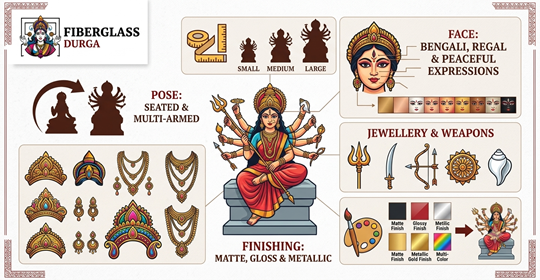
    What You Can Customise in a Fiberglass Durga Idol
    • Idol height — from 2-foot home shrine pieces to 12-foot pandal centrepieces
    • Style tradition — Bengali Ekchala, standalone Mahishasuramardini, or contemporary interpretations
    • Surface finish — high-gloss, matte, or decorative stone-effect
    • Colour palette — traditional reds and golds or bespoke colours to match your pandal design
    • Full deity set — matching Fiberglass Lakshmi, Saraswati, Ganesh, and Kartik figures

    Explore the full range of deity idols available from Fiberglass Durga: Fiberglass Ganesh Idol, Fiberglass Saraswati Idol, Fiberglass Laxmi Idol, and Fiberglass Maa Kali Idol.

    Choosing the Right Fiberglass Durga Idol Maker: What to Look For

    Not every manufacturer produces idols of equal quality. The difference between an outstanding Fiberglass Durga Idol and a disappointing one usually comes down entirely to the skill and integrity of the Fiberglass Durga Idol Maker you choose.

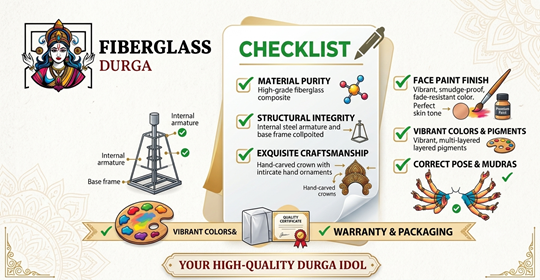
    Seven Things to Check Before You Commission Your Fiberglass Durga Idol
    1. Artisan credentials — do they have roots in traditional Kumartuli idol-making?
    2. Material quality — are they using high-grade fiberglass composite, not cheap alternatives?
    3. Portfolio — can they show you completed idols at the size and style you require?
    4. Export experience — do they have a proven record of shipping to your country?
    5. Customisation capability — can they genuinely deliver your specific requirements?
    6. Packaging standards — is their export crating rated for international freight?
    7. After-sales support — will they assist with maintenance advice and future orders?

    Fiberglass Durga meets every one of these criteria. With decades of combined artisan experience, a proven international export record, and a commitment to authentic Bengali craftsmanship, they are the trusted choice for puja committees and temple trusts across four continents.

    Conclusion: The Verdict on Fiberglass Durga Idol vs Traditional Clay

    When you weigh every factor — cost, durability, environmental compliance, artistic quality, shipping safety, and long-term value — the Fiberglass Durga Idol emerges as the clear choice for modern puja committees, particularly those celebrating in the USA, UK, Europe, and Australia.

    This is not about abandoning tradition. It is about honouring it more sustainably, more economically, and more responsibly. The same devotion that inspires every Durga Puja can now be expressed through an idol that endures — one that you bring home year after year, growing richer in memory and meaning with every celebration.

    Commission your Fiberglass Durga Idol from India’s most trusted Fiberglass Durga Idol Maker. Visit fiberglassdurga.com or explore the complete Fiberglass Durga Maa collection to find the perfect idol for your community this festive season.

    Order Your Fiberglass Durga Idol Today

    Contact: +91 72786 04751  |  fiberglassdurga.com

    Worldwide export to USA, UK, Europe & Australia.

    Custom sizes  •  Traditional craftsmanship  •  Export-grade packaging  •  Full end-to-end support

  • 🌸 Crossing Oceans Safely: The Ultimate Logistics Guide for Shipping a Fiberglass Durga Idol Abroad

    The Challenge Every Overseas Puja Committee Knows Too Well

    ⚡ Quick Summary
     • A Fiberglass Durga Idol weighs up to 60% less than clay, slashing international freight costs significantly.
    • Internal steel framing and multi-layer glass-fiber casting protect against transit damage.
    • ISPM-15 certified wooden crates with foam lining ensure safe delivery across any ocean.
    • Early production slot booking is essential for on-time Puja season arrival.

    Every year, thousands of Bengali families and cultural committees across the United States, United Kingdom, Europe, and Australia face the same formidable question: how do we bring Ma Durga home — across thousands of kilometres, through customs checkpoints, ocean containers, and airport cargo terminals — without her arriving damaged or costing a fortune in freight?

    The traditional answer was clay. But unbaked river clay, however beautifully sculpted, is structurally unforgiving when subjected to the pressures of international logistics. A single rough port handling, a temperature fluctuation inside a shipping container, or a vibration spike on a cargo aircraft can mean irreparable cracking — arriving just days before Shashti with a shattered idol and no time to replace it.

    The modern answer — adopted by hundreds of international Puja committees over the past decade — is the Fiberglass Durga Idol. This guide covers everything your committee needs to know about the freight economics, structural engineering, and export packaging that make a fiberglass Pratima the safest, smartest cross-border choice.

    Weight Matters: Breaking Down the Freight Economics

    Why Freight Cost Is Every Committee’s Biggest Anxiety

    International air freight is priced by whichever is greater: actual weight or volumetric weight. A traditional large clay Durga murti — inclusive of its wooden base and protective packing — can easily tip 200 to 400 kilograms. At standard air cargo rates, this translates into freight bills that frequently exceed the cost of the idol itself, making a grand Puja celebration feel financially out of reach for many diaspora committees.

    Sea freight is cheaper per kilogram, but introduces its own risks: longer lead times, humidity exposure inside containers, vibration from ocean swells, and rough port handling that clay simply cannot withstand.

    The Fiberglass Weight Advantage

    A professionally manufactured Fiber Durga Idol of equivalent visual dimensions to a traditional clay murti typically weighs 55 to 65 percent less. This is not a structural compromise — fiberglass achieves this through the inherent material properties of its polymer-and-glass-fiber composite, not through thinning walls or eliminating structural elements.

    The practical consequence for international committees is transformative:

    • Air freight bills reduced by 50% or more on equivalent idol dimensions
    • Sea freight becomes a genuinely viable option for even mid-size committees with adequate lead time
    • Customs duty calculations — which in many countries are weight-based — are proportionally reduced
    • Total landed cost (idol + freight + customs) becomes predictable and manageable for annual budgeting

    The Engineering Behind Transit Durability

    Internal Skeletal Framing: The Hidden Backbone

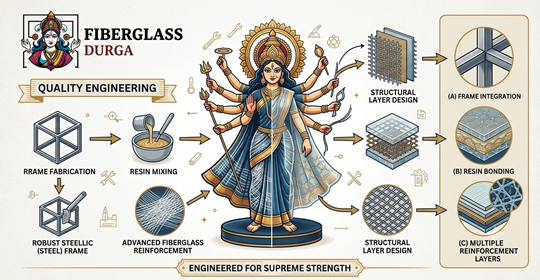
    What separates a premium Fiberglass Durga Idol from a hollow shell is the concealed internal structure. At Fiberglass Durga, every idol is built around a welded iron or mild steel skeletal frame, custom-engineered to the proportional geometry of each specific figure.

    This internal armature performs three critical transit functions:

    1. It distributes impact loads across the entire structure rather than concentrating stress at any single point — the primary cause of cracking in hollow-cast objects during rough handling.
    2. It prevents distortion under compressive forces — the kind applied by stacked cargo or tightened strapping during sea container loading.
    3. It provides a stable anchor for external packing materials, ensuring the idol cannot shift inside its crate during transit.

    The iron components are treated with anti-rust coating during production, protecting structural integrity across the humidity variations of long ocean voyages.

    The Multi-Layer Composite Cast: Why It Doesn’t Crack

    The fiberglass body itself is not a single-pour casting. Professional manufacturers apply glass-fiber matting in multiple cross-woven layers — each fully cured under controlled conditions before the next layer is applied. This cross-woven architecture is what gives fiberglass its legendary impact resistance.

    Think of it as the structural logic of plywood versus a single thick plank: the alternating grain directions of each layer cancel out the directional weakness of any individual layer, producing a composite that resists cracking from virtually any angle of impact. A Fiberglass Durga Maa Idol built to this standard can absorb transit stresses that would shatter a clay equivalent many times over.

    The Specialized Export Packaging Checklist

    Even the most structurally sound idol can be compromised by inadequate packaging. When evaluating a manufacturer’s export credentials, international committees should verify the following:

    • Shock-Absorbing Interior Lining: High-density expanded polyethylene (EPE) foam, custom-cut to the idol’s exact dimensional profile, should cushion every external surface with a minimum 50mm buffer on all sides.
    • Moisture-Resistant Wrapping: The idol should be individually wrapped in industrial-grade plastic film before foam packing — creating a sealed moisture barrier that protects against condensation inside shipping containers during temperature transitions.
    • ISPM-15 Certified Wooden Crates: All wooden packaging used in international shipments must comply with ISPM-15 phytosanitary standards (heat treatment and marking). Non-compliant wooden crates are routinely seized at customs in the USA, UK, EU, and Australia — causing costly delays and potential idol damage during inspection.
    • Corner and Edge Reinforcement: External crate corners should be reinforced with metal angle brackets. The idol’s most projecting elements — Mahishasura’s figure, Devi’s trident, the lion’s outstretched form — should receive additional individual foam protection.
    • Shock Indicator Labels: Professional export crates should carry internationally recognized fragile and orientation labels, along with tilt and shock indicator stickers that allow the receiver to document any mishandling that occurred during transit.

    Conclusion: Peace of Mind, Delivered Across Oceans

    The logistics of importing a deity idol for an international Puja celebration should never be a source of anxiety for your committee. With the right material — a professionally engineered Fiberglass Durga Idol — and the right manufacturer, the journey across oceans becomes a solved problem, not a gamble.

    The weight savings make international freight financially viable. The internal steel frame and multi-layer composite body make structural integrity near-certain. The export-grade packaging delivers Ma Durga to your community in exactly the condition she left the workshop.

    Your committee’s production slot should be booked 6–8 months before your Puja date to ensure on-time delivery. Browse the international delivery catalog at fiberglassdurga.com/idols_list/fiberglass-durga-idol-for-foreigners or call our team directly at +91-7278604751 to discuss your requirements and secure your commission.

Frequently Asked Questions

What is a Fiberglass Durga Idol?
Fiberglass Durga Idols are beautifully handcrafted sculptures of Goddess Durga made using fiber-reinforced plastic (FRP). They are lightweight, durable, reusable, unbreakable, weather proof, dust proof, washable, mild acid proof, mild chemical proof and resistant from fungus attack unlike traditional clay idols.
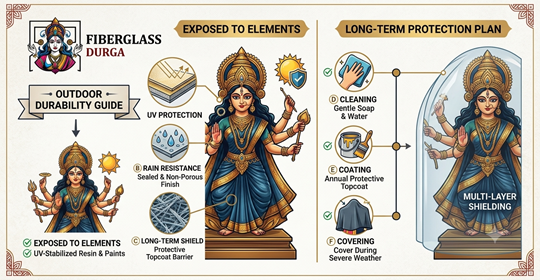
Yes, our idols are weather-resistant and can easily withstand rain, sun, snow, and dust, making them ideal for temples, gardens, or public spaces.

Absolutely! We offer fully customized Durga idols as per:

USA, UK, UAE, Netherlands, Germany, Cyprus, Japan, Canada, France, South Africa And Australia, We Handle:
Wooden structured box with plywood covered and inside of the box idols will be properly rapped with high quality soft polythine, sponge wrappers and bubble wrappers with protective padding to ensure safety and damage free delivery anywhere in the world.

Yes. We use high-quality, non-toxic, eco-friendly fiberglass  that meets international safety and quality standards.

Yes. Fiberglass Durga idols are designed for long-term use. With proper care and storage, they can be reused for many years, making them a cost-effective investment for Durga Puja committees.

We manufacture custom sizes  ranging from  2 feet to 20+ feet, depending on your requirement—ideal for home, community pujas, or public events.

Fiberglass Durga idols are ready to use idols. Just need to unpack from the box and use it for worship and after puja you can keep it safely in the packing box. In case needed we provide support via video call.